Field notes: how this handbook was built
From the target reader to three prototypes and the chosen design, a record of the initial local build.
Turn a broad website idea into a concrete, inspectable prototype.
On this page
01Choose the reader first
The initial idea was a website for Codex tutorials and reviews, with room for other models later. We chose Codex beginners using the desktop app as the first audience.
That choice shaped the lesson order and gave the homepage one clear starting point.
02Compare three prototypes
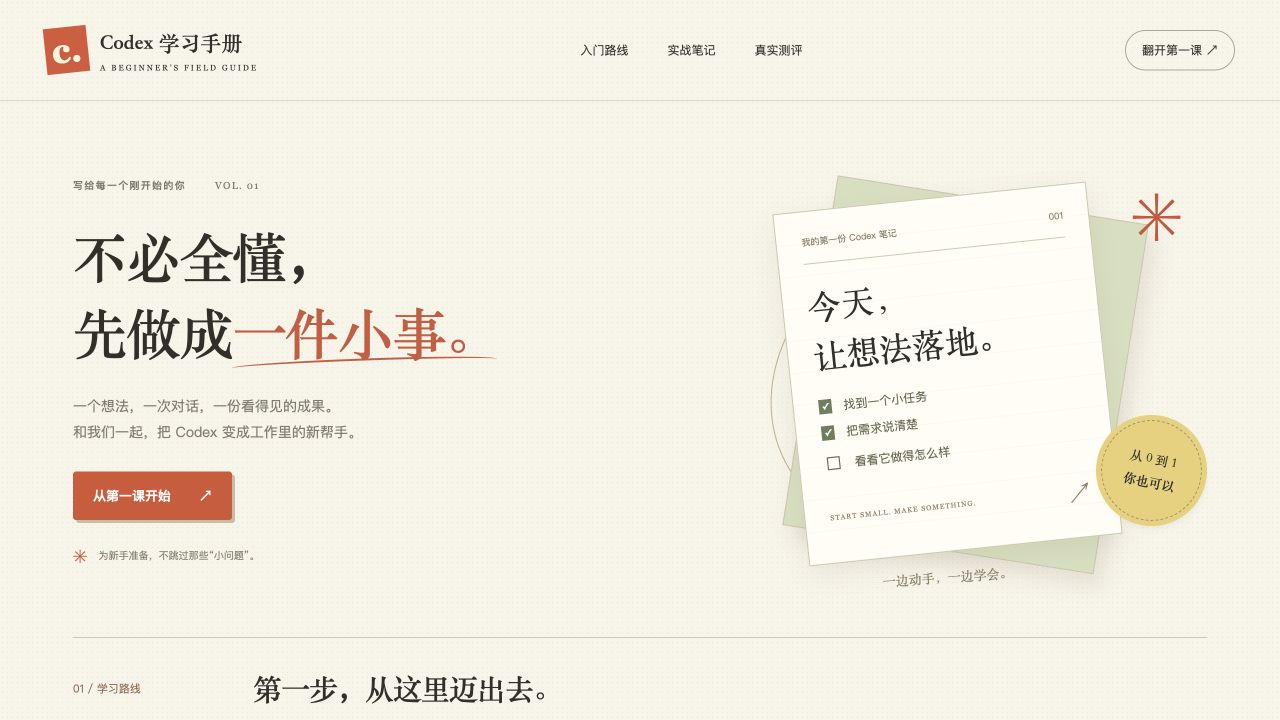
The first round contained three local homepages using the same content: A, a white-and-green documentation style; B, a warm learning handbook; and C, a dark task laboratory.
We chose B, retaining its paper palette, notebook illustration, and staged learning route.
03What that phase verified
The first round checked the three homepages, tutorial dialogs, search, and horizontal overflow at 390px. A decorative line in B initially extended beyond the page and was corrected.
This is a historical record of the local prototype phase, before public deployment. It recorded neither model speed nor cost, so it is not a performance benchmark.
04Apply the method to your project
Define the audience and main task, make prototypes comparable, then inspect the actual pages before choosing.
I want a [website type] for [target readers]. Their most important task is [one thing]. Create two local homepage prototypes with different structures but the same content so I can compare them. Explain when each works well. Do not publish yet.
Before you move on
Checklist progress stays in this browser. It is not uploaded or synchronized across devices.
About this article
This records the original local prototype and verification phase. Updated: 2026-10-02.